• 269: Faith Over Fear: Leading with Humanity in the Age of AI with Victoria Mensch
    Mar 3 2026

    Send a text

    In this insightful episode of Navigating the Customer Experience, we welcome Victoria Mensch, Founder & CEO of the Silicon Valley Executive Academy, for a powerful conversation on leadership, innovation, and thriving in the age of AI.

    With a PhD in Psychology, an MBA from UC Berkeley, and more than 25 years in Silicon Valley, Victoria has built her career at the intersection of human behavior, executive performance, and technological transformation. Arriving in Silicon Valley during the dot-com boom, she was inspired by its bold, world-changing mindset. That culture of innovation shaped her journey from working across semiconductor and software companies to launching her own executive academy, where she helps global leaders apply Silicon Valley’s innovation principles within their own organizations.

    A central theme of the episode is how leadership must evolve in today’s fast-changing 2026 environment. Victoria emphasizes that leadership isn’t limited to job titles—it exists at every level. She outlines three essential qualities leaders must cultivate:

    Self-Responsibility & Agency – Great leaders take ownership of their choices and focus on what they can control, even amid disruption.

    Curiosity – With technological, political, and economic shifts happening constantly, leaders must stay open, adaptable, and willing to explore new perspectives.

    Continuous Learning – In the age of AI, growth is non-negotiable. Leaders must embrace learning, develop new skills, and view change as an opportunity rather than a threat.

    One of the most powerful discussions centers on reframing failure. Victoria explains that fear of failure is often driven by imagined future scenarios. The key practice is returning to the present moment and rationally assessing reality. She also offers a mindset shift: the probability of success is equal to the probability of failure—yet we tend to focus only on what could go wrong. By consciously balancing those possibilities, leaders can make decisions rooted in clarity instead of fear.

    When asked for one word leaders should adopt for 2026, Victoria chooses humanity. As organizations increasingly integrate artificial intelligence, she believes leaders must keep the human element at the forefront. Technology should create space for deeper creativity and stronger connections—not replace them. The goal isn’t simply to be faster or more efficient, but to be better in how we serve and relate to others.

    Victoria also shares her excitement about AI-driven automation and tools that eliminate time-draining tasks, freeing leaders to focus on high-value work. She recommends exploring Lovable, a platform that allows users to build applications and landing pages without coding skills. A book that influenced her thinking is Digital Darwinism: Surviving the New Age of Business Disruption by Tom Goodwin, which examines how companies navigate digital transformation.

    Her personal guiding quote? “Faith over fear.”

    This episode delivers practical leadership insights for executives, entrepreneurs, and professionals ready to embrace change, lead with intention, and remain human in a rapidly evolving digital world.

    Connect with Victoria at www.svexecutive.academy and join the conversation on X @navigatingcx or in the Navigating the Customer Experience community.

    Show More Show Less
    20 mins
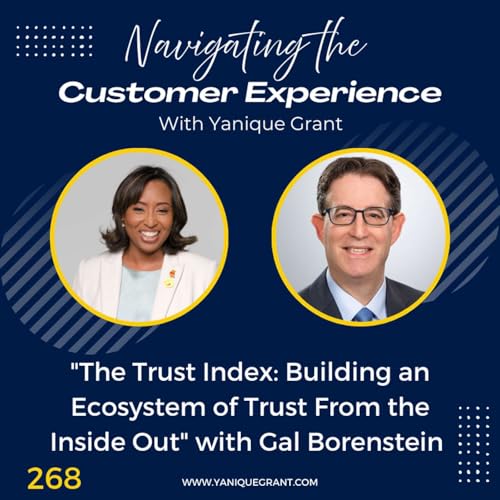
  • 268: The Trust Index: Building an Ecosystem of Trust From the Inside Out with Gal Borenstein
    Feb 17 2026

    Send a text

    In this episode of Navigating the Customer Experience, Gal Borenstein, Founder and CEO of The Borenstein Group, joins us for a powerful conversation on trust, branding, and customer experience in the digital and AI era. With nearly 30 years of experience advising growth-oriented organizations in complex and regulated industries, Gal shares how leaders can protect credibility and build sustainable brands when trust is on the line.

    Gal’s journey is a true immigration success story. Born and raised in Israel, he served as a military journalist before moving to the United States at 21 to pursue his education. After completing his undergraduate degree at Temple University in just two and a half years and earning a master’s degree from George Mason University, he quickly recognized a major gap in the marketplace: highly technical companies struggled to communicate their value clearly.

    Armed with a $2,000 loan and a vision, he launched The Borenstein Group in the Washington, DC area, focusing on helping B2B technology firms connect complex solutions to clear messaging. Over the past three decades, he has worked closely with CEOs and executive teams navigating cybersecurity, AI, advanced analytics, and government contracting—industries where trust, precision, and differentiation are critical.

    In this episode, Gal discusses his latest book, Don’t Believe the Hype: When Trust Is On The Line in the Age of Digital and AI, and explores what’s driving the breakdown of trust between brands and customers today.

    From his perspective, the erosion of trust accelerated with digital transformation and automation. As companies adopted CRM systems, AI tools, and scripted customer service processes, they unintentionally removed the human element that once anchored relationships. What used to be human-to-human trust has often become process-driven interaction—efficient, but emotionally disconnected. AI can execute tasks faster, but it cannot replace empathy, judgment, or values.

    Gal emphasizes that customer experience failures are rarely external problems alone. They usually reflect internal disconnects. Leadership may believe they are communicating clearly, while employees feel unheard or misaligned. Without internal trust, external trust collapses. He challenges organizations to develop a measurable “trust index” that identifies strengths, weaknesses, and perception gaps across departments.

    We also explore one of today’s biggest CX threats: fake reviews and AI-generated misinformation. In the past, companies largely controlled their narrative. Today, anonymous posts on review platforms and social media can shape perception overnight. Gal explains that reacting defensively is not enough. Brands must actively monitor conversations, engage in social listening, and integrate feedback into internal systems. Trust must become an ecosystem—shared by executives, middle management, and frontline employees alike.

    When asked about tools he relies on, Gal highlights LinkedIn as an essential knowledge hub, connecting professionals across industries and geographies. He also leverages AI platforms like OpenAI, while cautioning leaders to “trust but verify” due to AI hallucinations and inaccuracies.

    What excites him most right now is helping companies operationalize trust—turning it from an abstract value into a measurable, monetizable strategy that aligns culture, communication, and customer experience.

    His guiding mindset, inspired by Seinfeld, is both humorous and profound: “It’s not a lie if you believe it.” For Gal, this reflects the power of vision. When leaders truly believe in their narrative—and back it with integrity and proof points—they inspire teams, partners, and customers alike.

    This episode challenges CX leaders and business professionals to see trust as a cr

    Show More Show Less
    36 mins
  • 267: The CX Imperative: 5 Critical Practices for Making Customer Centricity a Core Business Value with Mark Fithian and Jeff Rosenberg
    Jan 27 2026

    Send us a text

    In this episode of Navigating the Customer Experience, we sit down with Mark Fithian and Jeff Rosenberg, cofounders of WideOpen, a strategic customer experience (CX) consulting firm, and authors of the book The CX Imperatives: Five Strategic Practices for Renewal of the Customer-Centered Enterprise. With more than 30 years of experience each, Mark and Jeff bring deep insight from working across industries including healthcare, technology, automotive, consumer goods, and professional services.

    Mark and Jeff share their professional journeys and the “red thread” that has guided their careers: a commitment to understanding customers as humans, not just data points. From early roles in marketing, operations, and consulting, both authors describe moments when they realized organizations often make decisions without considering how customers truly experience them. That realization ultimately led to the founding of WideOpen and the development of the frameworks outlined in their book.

    The conversation centers on The CX Imperatives and its purpose as a practitioner’s guide for CX leaders and professionals who already care about customer experience and want to embed customer centricity across the enterprise. Rather than focusing on one-off “wow moments,” the book emphasizes creating consistent, meaningful experiences across the entire customer journey that align with business strategy and drive growth and innovation. Importantly, the authors stress that the principles are industry-agnostic, applicable to both B2B and B2C organizations of all sizes.

    Mark outlines the book’s five strategic CX practices:

    1. Insights – deeply understanding customers as emotional, human beings, not just metrics;
    2. CX Strategy – aligning customer insights with business objectives to focus effort where it matters most;
    3. Blueprinting – translating strategy into operationally actionable designs;
    4. Operating Model – enabling cross-functional collaboration through roles, processes, and shared accountability; and
    5. Culture – ensuring employees understand, believe in, and are equipped to deliver the intended experience.

    Through real-world examples, including healthcare, Mark and Jeff demonstrate how engaging frontline employees and embedding CX into culture can generate both tangible outcomes (cost savings, growth initiatives) and intangible benefits (employee ownership, sustainability, and trust).

    The discussion also explores the connection between internal culture and external customer experience, with both guests agreeing that consistently poor CX is often a symptom of internal organizational challenges. They share practical advice for CX leaders navigating varying levels of leadership support, emphasizing the importance of meeting stakeholders where they are and addressing resistance with empathy and clarity.

    To bring CX to life, Mark and Jeff each share standout customer experiences—from thoughtful airline journey improvements to an unexpectedly empowering healthcare onboarding experience—illustrating how intentional design can transform how customers feel.

    The episode wraps with personal insights into the tools, books, and mindsets that inspire them today, reflections on why this is an exciting time for the CX discipline, and where listeners can connect with them and learn more about their work, workshops, and book.

    This episode is a must-listen for leaders and practitioners looking to move beyond surface-level CX and build customer-centered enterprises that deliver sustainable value for both customers and the business.

    Show More Show Less
    31 mins
  • 266: Leading From the Inside Out: Voice, Peace, and the Power of People with Jeremie Kubicek
    Jan 6 2026

    Send us a text

    In this episode of Navigating the Customer Experience, we sit down with Jeremie Kubicek, a powerful communicator, serial entrepreneur, and co-founder of GiANT, a global leadership development company. Jeremie is the author of several influential leadership books, including 5 Voices, 5 Gears, The 100X Leader, The Peace Index, and his newest release, The Voice-Driven Leader.

    Jeremie shares his entrepreneurial journey and explains how years of building businesses taught him a critical lesson: while business plans and financial plans matter, it is the people plan that most often determines success or failure. Early in his career, he realized that people were often treated as liabilities rather than assets. This insight led him to dedicate his work to helping leaders understand, develop, and empower people so they can truly thrive.

    At the heart of the conversation is Jeremie’s new book, The Voice-Driven Leader. He explains that the most important role in any organization is the team leader—the person who leads people day-to-day. Using the metaphor of a “Sherpa,” Jeremie emphasizes that when a leader is healthy and self-aware, the team they lead is far more likely to be healthy as well. The book helps leaders understand their own voice, personality, and wiring, as well as the voices of those they lead, so they can communicate more effectively and create meaningful development plans.

    Jeremie outlines several core leadership principles, especially for those transitioning from peer to leader. These include learning to “speak the language” of others rather than forcing them to adapt to your style, clearly defining expectations and development paths, and guiding people through the discomfort of learning—what he calls the “pit of despair.” By understanding how people are wired and how they respond under stress, leaders can better support growth and avoid unnecessary breakdowns.

    The conversation also explores how communication has evolved, particularly across generations, and how small misunderstandings—tone, emojis, or short messages—can unintentionally damage relationships if leaders are not intentional and aware.

    Jeremie shares what excites him most right now: his focus on the idea that peace is power. He explains that leaders cannot give what they do not possess. If a leader is not at peace internally, their leadership and customer experience efforts will feel transactional rather than authentic. He introduces The Peace Index, a practical framework that helps individuals assess peace across five areas of life, reinforcing the idea that personal well-being directly impacts professional effectiveness.

    Listeners also hear about the tool Jeremie uses daily—the 5 Voices App, an AI-powered resource designed to help people navigate communication, relationships, and leadership based on personality dynamics. He recommends Unreasonable Hospitality by Will Guidara as a book that deeply influenced his thinking on journeys, employee experience, and customer experience.

    Jeremie closes by sharing simple yet powerful phrases he uses during challenging times, including “Choose joy” and “Call up, not out,” reminding us that leadership begins within. This episode is a compelling reminder that great customer experiences start with healthy, self-aware leaders who are alive, at peace, and intentional about how they show up every day.

    Connect with Jeremie Kubicek

    www.jeremiekubicek.com

    Show More Show Less
    23 mins
  • 265: Why Feelings Drive Growth: Emotional Equity, Belonging & Brand Transformation with Jean-Pierre LaCroix
    Dec 9 2025

    Send us a text

    In this episode of Navigating the Customer Experience, we sit down with Jean-Pierre LaCroix—President and Chief Strategy Officer of SLD, brand visionary, author, and creator of groundbreaking tools such as the Trust Ladder and the Ideal Omni Experience Model. With more than 46 years of experience helping global organizations transform their retail, brand, and customer experience ecosystems, Jean-Pierre brings deep insight into what it truly takes to build emotionally resonant brands.

    Jean-Pierre begins by sharing his personal journey—from growing up on an Air Force base in Germany to working long days on his family’s farm, to discovering his passion for design at Sheridan College. Launching his first firm just two years after graduating, he eventually built SLD into a leading global strategic design agency.

    He then dives into his latest book, ThinkBlink Manifesto, which distills decades of experience into seven core tenets for creating emotionally connected brands. Jean-Pierre explains why emotional equity—not features, benefits, or promotions—is what customers respond to most deeply. The seven tenets include:

    1. Owning the Emotional Moment
    2. Personifying the Emotional Value Through Design
    3. Communicating a Compelling Brand Story
    4. Understanding Target Personas Beyond Demographics
    5. Creating Belonging Experiences
    6. Measuring What Truly Matters (Emotional Metrics)
    7. Future-Proofing the Brand

    Jean-Pierre discusses how leaders can shift beyond pre-COVID thinking by embracing new metrics, strengthening community and belonging for employees and customers, and leveraging SLD’s newly launched ThinkBlink AI Assessment tool to evaluate emotional connection, differentiation, and future readiness.

    He also highlights companies that exemplify these principles—such as Apple, Harley-Davidson, and Canadian innovator Cineplex—organizations that have built loyalty and community through purpose-driven experiences.

    A voracious reader, Jean-Pierre shares the books that have shaped him most, including Blue Ocean Strategy, The Challenger Mindset, and Nudge. He also opens up about what he’s currently excited about: becoming a grandfather and being invited once again as a keynote speaker at the Financial Brand Forum.

    To close the episode, he shares his personal mantra for challenging times:
    “Leadership is about seeing the opportunity in the challenges versus the challenges in the opportunity.”

    Connect with Jean-Pierre on LinkedIn or visit www.sld.com
    for tools, insights, and free resources.

    Show More Show Less
    28 mins
  • 264: No One-Size-Fits-All CX: Ty Givens on Playbooks, People and Performance
    Nov 18 2025

    Send us a text

    In this episode of Navigating the Customer Experience, we sit down with Ty Givens, the dynamic Founder and CEO of CX Collective, a consultancy known for building customer experience programs that scale while still feeling human. With a career that began at just 18 years old, Ty walks us through her remarkable journey from her first customer service desk at Office Depot to leading global teams and eventually launching her own company nine years ago.

    Ty shares how an early promotion into workforce management shaped her analytical mindset and laid the foundation for her future leadership roles. After years of being called in to “fix” support operations, she recognized that real transformation requires more than one person—it requires systems, collaboration, and a dedicated team. That realization became the catalyst for starting CX Collective.

    One of her greatest rewards today is witnessing the tangible results of her team’s work—whether it's improving a help center’s searchability or strengthening an AI knowledge base. Ty describes herself as results-driven and energized by project-based outcomes that create long-term value for clients.

    Ty also opens up about the emotional challenges of leading support teams. Early leadership training at Intuit, combined with her MBA in Organizational Leadership, helped her develop a grounded approach centered on emotional intelligence, inquiry, and humility. Recognizing her strengths as an operator rather than a novice-leader coach, she began developing CX playbooks—practical guides that help leaders navigate common challenges, from time management to launching AI programs. These playbooks have become both her most essential tool and a source of self-reflection.

    Ty talks about the importance of community, staying curious about industry trends, and the advantage of having worked inside many different organizations. She also shares the fiction authors who shaped her love for storytelling—Eric Jerome Dickey and Carl Weber—and why their writing continues to resonate.

    We also explore what Ty is most excited about these days: celebrating her niece’s freshman year at Tuskegee University and being stretched professionally as she leans into marketing her playbooks to a broader audience—an entirely new frontier after years of organic, word-of-mouth growth.

    Ty closes the conversation with two powerful affirmations from her grandparents that guide her through adversity:

    “You can do anything you put your mind to,” and “Lace up your bootstraps.” These messages remind her to stay grounded, confident, and ready to face whatever comes.

    Connect with us on X @navigatingcx and join our private Facebook community, Navigating the Customer Experience.

    Show More Show Less
    23 mins
  • 263: Empowering Teams and Elevating CX with Jamie Homen
    Nov 4 2025

    Send us a text

    In this episode of Navigating the Customer Experience, we dive deep into the career and mindset of Jamie Homen, a seasoned customer experience (CX) leader with over 20 years in the industry. Now leading CX at Mural, an AI-powered visual collaboration platform, Jamie shares valuable perspectives on effective leadership, cross-functional alignment, and how customer-centric decisions drive business success.

    🛤️ Jamie’s Journey into Customer Experience

    Starting as a call center agent, Jamie never anticipated becoming a Chief Customer Officer. He has watched the field mature and is now thrilled to see customer experience earn a seat at the executive table. At Mural, he’s helping customers visualize collaborative work in a remote world, which he believes is central to modern CX strategies.

    💡 Key Leadership Insights

    To drive customer success in today’s dynamic environment, Jamie focuses on two major practices:

    1. Cross-Functional Alignment: Ensuring teams like sales, marketing, product, and CX operate cohesively. He emphasizes co-creation to close gaps and build customer-centric processes.
    2. Empowering Teams: Encouraging employees at all levels to make customer-first decisions, supported by ongoing development and understanding of individual skill sets—especially as AI reshapes roles.

    🧠 Overcoming Challenges

    Jamie shares a personal story: in high school, he was told he shouldn't pursue college. Refusing to let that define him, he pushed forward and earned three degrees. This experience now fuels his belief in perseverance and self-motivation—key traits he brings into his leadership.

    🛠️ Can’t-Live-Without Tool

    ChatGPT tops Jamie’s list for its ability to generate ideas, create personas, and gather insights. He predicts a growing shift from traditional search platforms to AI-powered tools across industries.

    📚 Book Recommendation

    Managing Up by Rosanne Badowski has had a lasting impact on Jamie’s leadership approach, especially in building effective relationships with managers—a skill he considers timeless despite changing workplace technology.

    🤖 What’s Exciting Jamie Now

    AI transformation. He’s focused on integrating AI across Mural to better understand customers and enhance internal workflows without losing the human element—AI as an enabler, not a replacement.

    💬 Favorite Quote

    Adversity introduces a man to himself.” — Albert Einstein
    Jamie uses this quote as a reminder to reflect, grow, and persist through obstacles.

    🔗 Connect with Jamie

    LinkedIn – Jamie Homen
    Website – mural.co/blog

    Thanks for tuning in! Be sure to follow us on X @navigatingcx and join our private Facebook community: Navigating the Customer Experience.

    Show More Show Less
    18 mins
  • 262: You Miss Every Shot You Don’t Take: Evan Siegel on Innovation, Leadership & AI-Driven CX
    Oct 21 2025

    Send us a text

    In this episode of Navigating the Customer Experience, we sit down with Evan Siegel, Vice President of AI at eGain, where he leads the development of next-generation AI-powered conversational guidance. With a rich background that includes 16 years at Wells Fargo leading customer experience and contact center innovation, Evan brings deep insight into how technology can drive better service outcomes without losing the human touch.

    Evan’s career journey began in entrepreneurship — running a successful residential painting business that grew to 300 employees before he sold it and pursued an MBA at Stanford. His experience at Wells Fargo honed his expertise in solving large-scale customer pain points and improving first-contact resolution in massive contact centers. Those experiences led him to eGain, a company dedicated to providing “the right answer to the right person at the right time, in the right channel.”

    Evan explains that eGain’s AI-powered knowledge management platform helps companies clean, update, and centralize information so agents can quickly find accurate answers. This not only improves customer satisfaction but also transforms efficiency—some clients have seen up to 37% improvement in first-contact resolution, a 30-point rise in Net Promoter Score, and 50% reduction in training time. For instance, eGain supports the U.S. Veterans Administration, the country’s largest healthcare provider, to deliver consistent, fast, and empathetic service across millions of interactions.

    A key theme in the discussion is balancing technology and empathy. Evan emphasizes that AI doesn’t replace human connection—it enhances it by freeing up employees’ mental space to focus on emotional intelligence and rapport-building. By handling the “how” of issue resolution, AI lets people focus on the “who.”

    He also shares how eGain builds knowledge bases for each company by analyzing customer inquiries, extracting top issues using AI, and rewriting existing materials to align with best practices for clarity and accessibility. This process—once lengthy and manual—can now be done in days or weeks.

    When asked about tools he can’t live without, Evan points to AI assistants like ChatGPT, Claude, and Perplexity, which he uses daily as brainstorming and writing partners. His motto: “AI won’t replace me, but someone who knows how to use AI better than me will.”

    Evan also discusses two books that shaped him: How to Win Friends and Influence People by Dale Carnegie, which taught him the power of genuine curiosity in relationships, and William Manchester’s three-part biography of Winston Churchill, which inspired lessons in conviction, communication, and strategic thinking.

    Today, what excites Evan most is collaborative leadership—bringing teams together to brainstorm, check egos at the door, and make the best collective decisions. His guiding philosophy: “I don’t need to be the smartest person in the room. I need to make the best decision coming out of the room.”

    He closes with another favorite quote: “You miss every shot you don’t take.” For Evan, this embodies the spirit of innovation at eGain—experiment fast, learn fast, and keep improving.

    Listeners can connect with Evan on LinkedIn or email him at esiegel@egain.com
    to learn more about eGain’s new AI self-service agent for small businesses, featuring reasoning capabilities, a free trial, and no-contract flexibility.

    Follow us on X @navigatingcx, and join our Navigating the Customer Experience Facebook community for more insights and resources.

    Show More Show Less
    23 mins